

Introduction
For more than 50 years, human labor management was guided by an “idealized” curve depicting cervical dilation over time and shaping care around the world. In the last twenty years, new research has questioned this approach.
This has created a key clinical challenge: balancing the need to identify labor dystocia to prevent harm with the risk of labeling normal, slower labor as a problem.
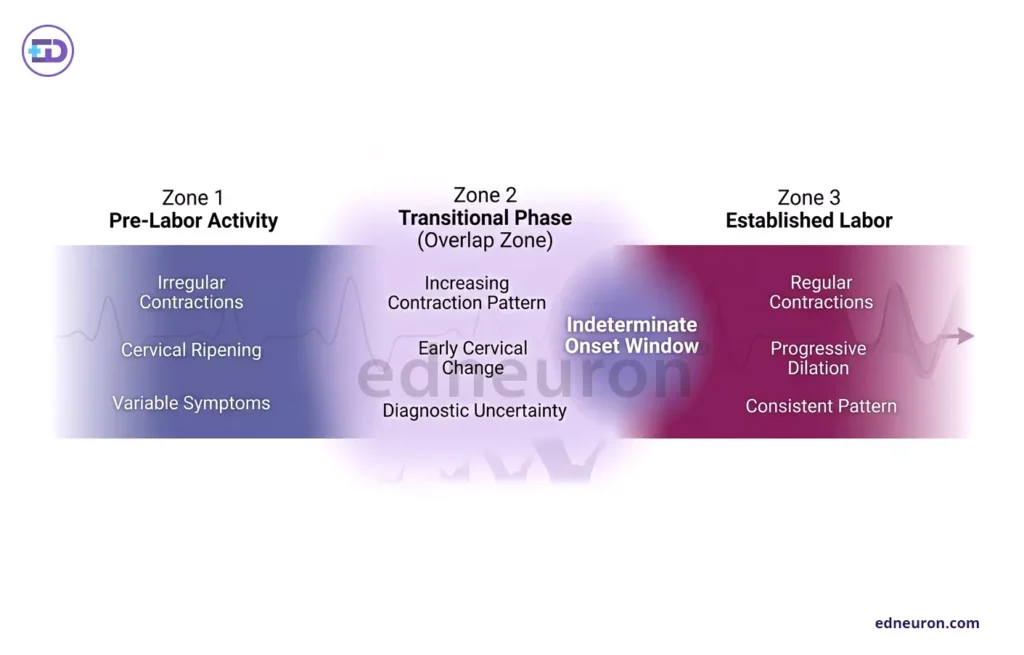
Fig 1: Overlapping pre-labor and early labor phases highlight the diagnostic uncertainty in defining the true onset of labor.
The Ambiguity of Onset: A Diagnostic Blind Spot
Diagnosing when labor truly begins is one of the hardest decisions in maternity care, but it forms the basis for all later assessments of progress. Although the first stage of labor is initiated by a complex mix of biological signals, such as decidual activation, inflammatory cytokines (such as IL-1β and TNF), and increased oxytocin receptors in the uterus, these changes cannot be directly observed during care.
Consequently, clinicians rely on crude measures like cervical dilation and reports of regular contractions, which can lead to diagnostic errors. Older standards (Friedman) set the start of active labor at 3 to 4 cm, but newer research shows that for many women, the “acceleration phase” often does not start until 6 cm. This means that reaching active labor at different dilation points is common and not a sign of a problem. If we stick to a fixed 4 cm rule, we may mislabel many healthy labors as “dystocia” and intervene too soon, thereby challenging the traditional linear alert-line model of labor progression.
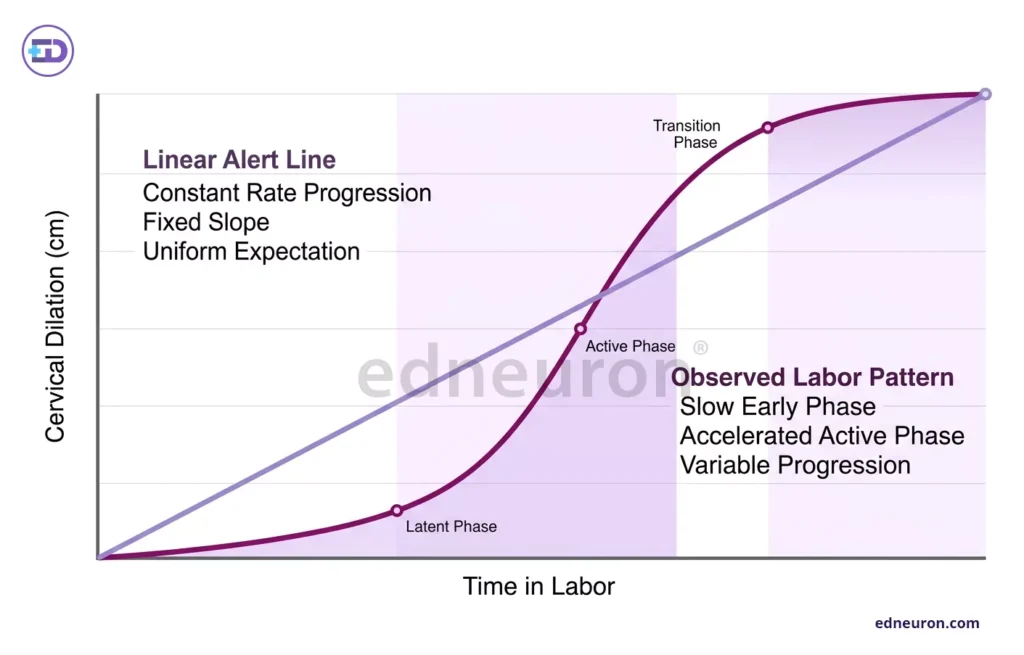
Fig 2: Nonlinear cervical dilation patterns challenge the traditional linear alert line model of labor progression.
The Fallacy of the Linear Alert Line
After diagnosing “active” labor, the traditional approach has used the 1 cm/hour “alert line” to determine when to intervene. However, research now shows that this rule is not very accurate at finding women who are truly at risk for serious birth problems, with a sensitivity at 56.7% and a specificity at 51.1%. This leads to an important question: if the alert line often gets it wrong, does using it just increase unnecessary risks without making birth safer?
Research shows that labor does not always progress in a straight line. Today, first-time mothers often have slower labor than in the past, and using neuraxial anesthesia can make the second stage last twice as long, sometimes over an hour. Although longer labors are linked to higher risks of problems like postpartum bleeding, infection, and newborn ICU admission, these risks are not just due to time. They are often affected by how well the labor is monitored and how quickly care is given.
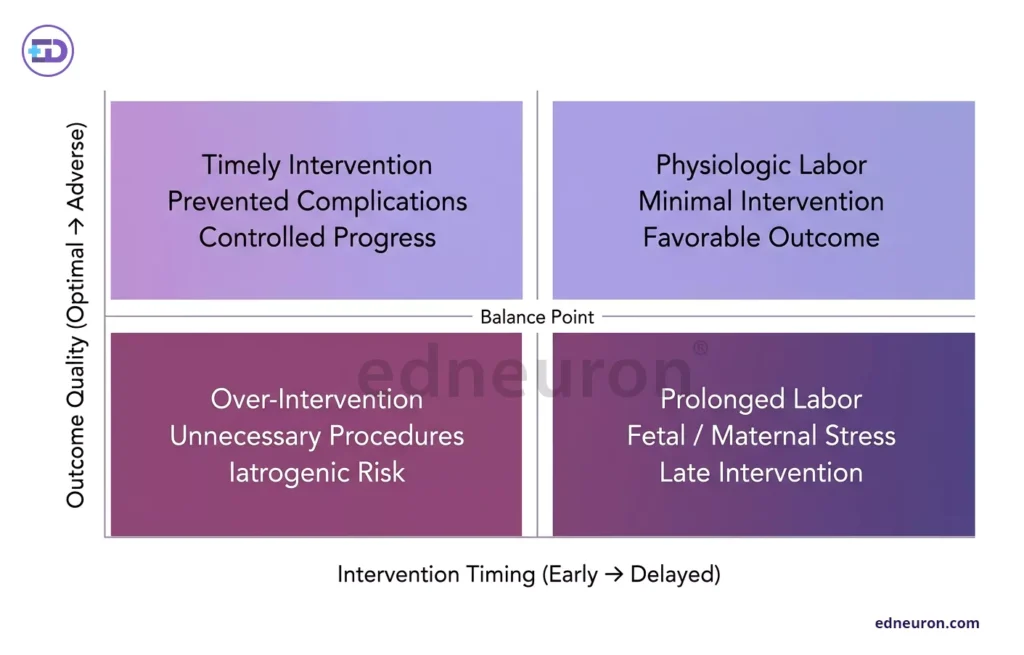
Fig 3: Quadrant matrix illustrating the balance between timing of intervention and clinical outcomes in labor.
Clinical Outcomes and the Paradox of Intervention
The main challenge arises when both mother and baby are doing well, but labor is slow. Allowing first-time mothers to push for at least three hours has been shown to lower the rate of first-time cesarean deliveries without greatly increasing overall risks to the mother. Still, this careful waiting needs balance, since every extra hour of pushing brings a higher chance of problems like perineal tears and weak uterine muscles.
Modern labor is further complicated by medical interventions. Treatments like giving oxytocin or using epidurals change the usual pattern of labor, so it becomes very hard to know what the natural course would have looked like.
Toward an Integrated Clinical Framework
Statistics by themselves cannot solve the problem of defining labor dystocia. A case that falls outside the usual range, like at the 95th percentile, should only be acted on if there is clear clinical evidence of risk. In the future, care will likely need to go beyond just checking the cervix by hand and use more objective, ongoing tools like ultrasound or lab markers to tell if a baby is safely progressing or starting to have problems.
Conclusion
In summary, moving from strict timing rules to a more flexible, personalized approach to labor is an important step forward in obstetrics. The main goal is not to make labor fit a perfect curve, but to protect the health and experience of the person giving birth while keeping safety as the top priority. This means focusing on the patient, not just the clock, and recognizing that labor is a continuous, highly individual process.
References
- Hanley GE, Munro S, Greyson D, Gross MM, Hundley V, Spiby H, et al. Diagnosing onset of labor: a systematic review of definitions in the research literature. BMC Pregnancy Childbirth. 2016;16:71.
- Diaz V, Abalos E, Carroli G. Normal labor: physiology, evaluation, and management. In: StatPearls [Internet]. Treasure Island (FL): StatPearls Publishing; 2023. Available from:
- Soni A, Kumar D. The second stage of labor. Int J Reprod Contracept Obstet Gynecol. 2019;8(11):4550–4555.
- Vahratian A, Zhang J, Troendle JF, Sciscione AC, Hoffman MK. New insights on labor progression: a systematic review. Am J Obstet Gynecol. 2022;227(2):185–194.
- Smith V, Devane D, Begley CM, Clarke M. Duration of the second stage of labor in low-risk women: a systematic review. BMC Pregnancy Childbirth. 2013;13:19.

Author: A D
A surgically inclined medical trainee with a growing interest in brain, spine, and cardiothoracic systems, aspiring to build a career in advanced operative care. He aims to become a patient-centered surgeon who integrates evolving medical technologies with precise clinical judgment. With a strong foundation in surgical sciences, he has gained clinical exposure through case postings involving breast pathologies, chronic ulcers, and diabetic foot, along with observational experience in hernia repair, appendectomy, and cholecystectomy. Academically, he has assisted research work on breast cancer and developed a case report on a complicated hernia surgery, alongside contributing multiple review articles across disciplines. He is currently engaged in ongoing research exploring the role of nutrition in health and disease. MBBS (MS4) GMC Nagpur, India