
Introduction
For decades, atopic dermatitis (AD) was confined to a dermatological silo, viewed primarily as a localized, albeit distressing, eczematous eruption of childhood. Yet, as our understanding of the epidermal-immune interface deepens, this reductionist view becomes increasingly untenable. What emerges is a heterogeneous systemic inflammatory disease in which the skin serves as both the primary site of injury and the gateway to a lifetime of multi-organ comorbidities. This raises a fundamental clinical tension: is atopic dermatitis merely a symptom of a systemic predisposition, or is the skin barrier’s failure the primary driver of the systemic inflammatory cascade?
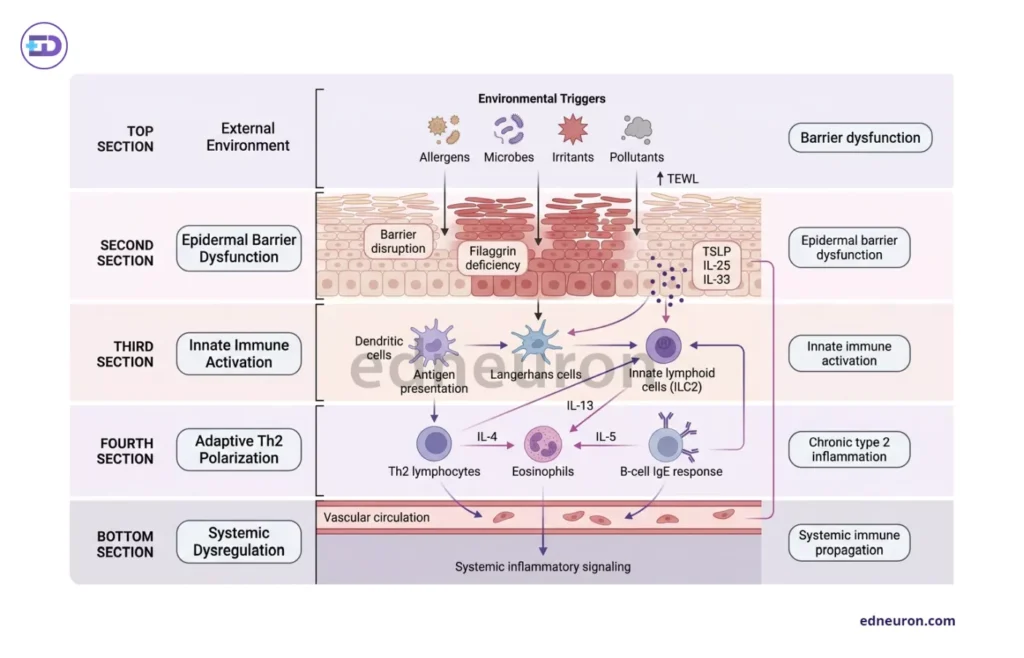
Fig 1: The outside-in model of atopic dermatitis linking epidermal barrier disruption to chronic systemic immune activation.
The Barrier as a Gateway: The “Outside-In” Mechanism
The structural integrity of the stratum corneum is maintained by a delicate “brick and mortar” architecture. In this model, filaggrin (FLG) processing products provide essential hydration as natural moisturizing factors (NMF). In patients harboring loss-of-function FLG mutations, the strongest known genetic risk factor for AD, this barrier is fundamentally compromised. This is not merely a matter of “dry skin”; it is a functional failure that facilitates the percutaneous penetration of allergens and pathogens.
Evidence suggests that this barrier breach is the literal starting point of the “atopic march”. When the skin’s defense fails, environmental antigens encounter Langerhans cells and dermal dendritic cells, triggering a Th2-skewed immune response long before respiratory symptoms manifest. What complicates this further is that the inflammation itself becomes a feed-forward loop: Th2 cytokines such as IL-4 and IL-13 directly downregulate filaggrin expression and ceramide production, effectively worsening the very barrier defect they exploit.
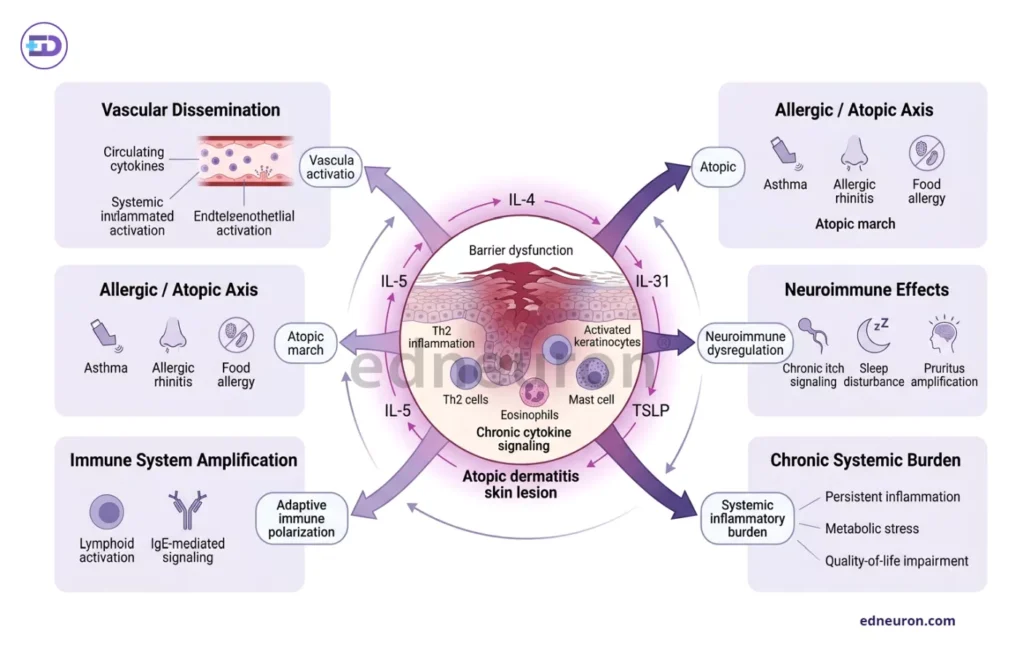
Fig 2 : Th2-driven inflammation in atopic dermatitis propagates beyond the skin to produce systemic immune and neuroinflammatory effects.
The Th2 Umbra: Local Inflammation, Systemic Reach
While the clinical hallmarks of AD are cutaneous, the underlying immunological dysregulation is systemic. The hallmark Th2 polarization leads to elevated serum IgE levels and peripheral eosinophilia, which correlate with the development of asthma in up to 50% of patients and allergic rhinitis in over 40%.
The clinical implication is profound: AD should be viewed as the skin-based manifestation of a systemic “Type 2” inflammatory endotype. This is most evident in the high incidence of non-atopic comorbidities, such as cardiovascular disease and psychiatric disorders. While the absolute risk for cardiovascular events remains low, chronic low-grade systemic inflammation in severe AD may mirror atherosclerotic pathways. More striking is the psychiatric burden; the risk of depression and anxiety is significantly increased, driven by a combination of pro-inflammatory cytokines potentially crossing the blood-brain barrier and the devastating impact of chronic sleep deprivation from nocturnal pruritus.
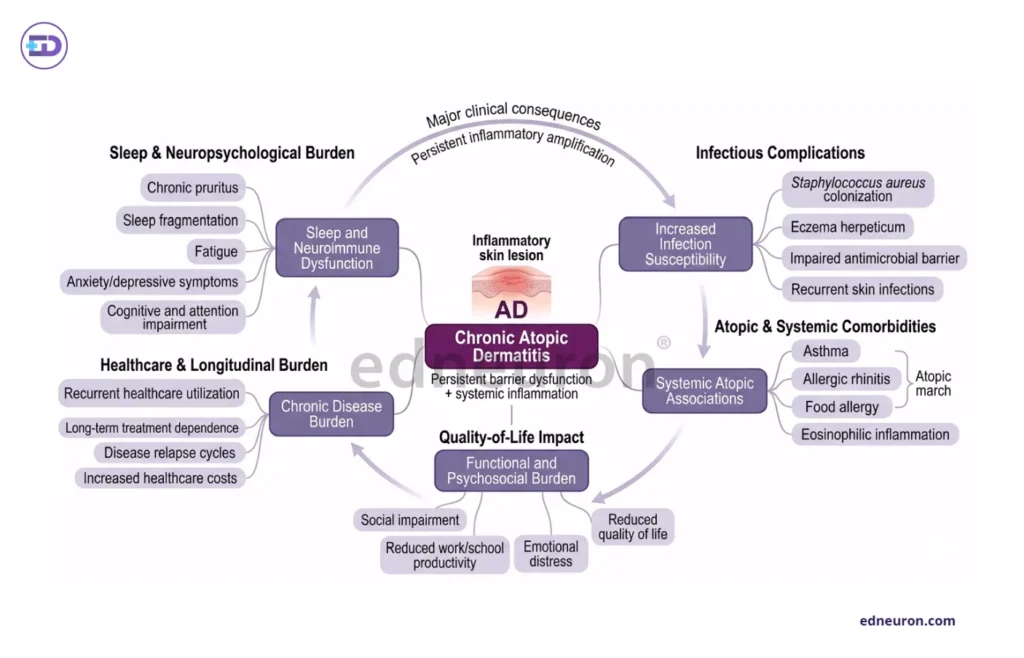
Fig 3 : Systemic, psychosocial, and longitudinal consequences associated with chronic atopic dermatitis and persistent inflammatory dysregulation.
Clinical Outcomes and Real-World Implications
Applying this knowledge means doctors should treat the whole disease, not just the skin symptoms. Targeted drugs like dupilumab, which block the IL-4 and IL-13 receptor, show the value of treating the body-wide Th2 pathway. However, patients may respond differently. For instance, some Asian patients exhibit a distinct immune profile (Th17), which may require alternative treatments. Also, while treating the whole body can help the skin, doctors need to monitor for side effects, such as eye issues or Th17-related arthritis.
Conclusion
Doctors should stop thinking of atopic dermatitis as only a skin issue and start treating it as a body-wide ‘Type 2’ condition. The main question is whether starting treatment early and focusing on the skin barrier or the immune system can really prevent the atopic march. Seeing AD as an early warning sign means working together with other specialists, not just dermatologists.
- Key Clinical Takeaway: AD clearly shows body-wide inflammation and puts patients at risk for long-term problems in several organs.
- Management Implication: Clinicians should shift from only treating skin symptoms to actively monitoring the whole body and starting early treatment to reduce long-term mental health and breathing problems.
References
- Weidinger S, Beck LA, Bieber T, Kabashima K, Irvine AD. Atopic dermatitis. Nat Rev Dis Primers. 2018;4(1):1.
- Paller AS, Spergel JM, Mina-Osorio P, Irvine AD. The atopic march and atopic multimorbidity: many trajectories, many pathways. J Allergy Clin Immunol. 2019;143(1):46-55.
- Langan SM, Irvine AD, Weidinger S. Atopic dermatitis. Lancet. 2020;396(10247):345-360.
- Drucker AM, Wang AR, Li WQ, Sevetson E, Block JK, Qureshi AA. The burden of atopic dermatitis: summary of a report for the National Eczema Association. J Invest Dermatol. 2017;137(1):26-30.
- Brunner PM, Guttman-Yassky E, Leung DYM. The immunology of atopic dermatitis and its reversibility with broad-spectrum and targeted therapies. J Allergy Clin Immunol. 2017;139(4S):S65-S76.
- Patruno C, Napolitano M, Argenziano G, Balato A, Ayala F, Megna M, et al. Atopic dermatitis and skin microbiota: a review. Clin Cosmet Investig Dermatol. 2016;9:383-389.
- Furue M, Ulzii D, Vu YH, Tsuji G, Kido-Nakahara M, Nakahara T. Pathogenesis of atopic dermatitis: current paradigm. Iran J Immunol. 2019;16(2):97-107.
- Bieber T. Atopic dermatitis. Ann Dermatol. 2010;22(2):125-137.

Author: A D
A surgically inclined medical trainee with a growing interest in brain, spine, and cardiothoracic systems, aspiring to build a career in advanced operative care. He aims to become a patient-centered surgeon who integrates evolving medical technologies with precise clinical judgment. With a strong foundation in surgical sciences, he has gained clinical exposure through case postings involving breast pathologies, chronic ulcers, and diabetic foot, along with observational experience in hernia repair, appendectomy, and cholecystectomy. Academically, he has assisted research work on breast cancer and developed a case report on a complicated hernia surgery, alongside contributing multiple review articles across disciplines. He is currently engaged in ongoing research exploring the role of nutrition in health and disease. MBBS (MS4) GMC Nagpur, India